How to Remove Hard Water Stains From Your Windows
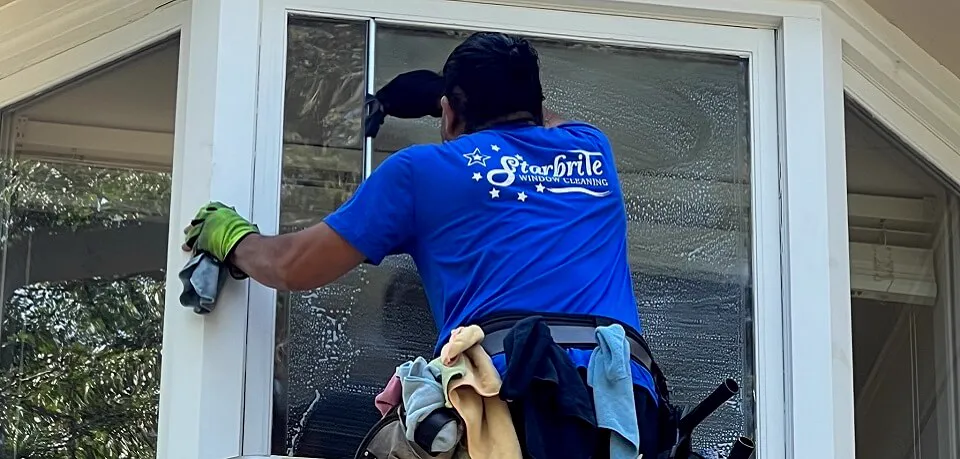
You've washed the window twice, and those cloudy white spots are still sitting there, staring back at you. Here's why: hard water stains aren't dirt, so soap and water won't touch them. They're mineral deposits, and removing them takes a mild acid — plain white vinegar handles fresh spots, older stains need stronger treatment, and stains left for years may have permanently etched the glass. Our crews have dealt with every stage of hard water staining across more than 12,000 Twin Cities homes, so here's the full picture: how to remove the stains you can, how to recognize the ones you can't, and how to keep them from coming back.
What Hard Water Stains Actually Are
When water sits on glass and evaporates, the water leaves but the minerals dissolved in it — calcium, magnesium, and silica — stay behind as a chalky white residue. One drop leaves a faint ring. But when the same glass gets wet and dries over and over, the deposits build up in layers, bond to the surface, and slowly begin to react with the glass itself. That's why glass cleaner does nothing: you're not trying to lift dirt off the surface, you're trying to dissolve rock. It's the same crusty buildup you see on a showerhead or around a faucet — just spread thin across your window.
First, Find Where the Water Is Coming From
Before you scrub anything, figure out what keeps wetting the glass. Remove the stains without fixing the source and they'll be back within weeks. The usual suspects:
- Lawn sprinklers that overspray onto windows — far and away the most common cause we see in the Twin Cities
- Rain running off brick, concrete, or stucco above the window, carrying minerals onto the glass below
- Well water, common in the outer metro, which tends to be extremely mineral-heavy
- Washing windows with a garden hose and letting hard tap water air-dry on the glass
- A leaky gutter or downspout dripping across the same pane every time it rains
The Vinegar Method for Fresh Stains
For spotting that's weeks or months old — not years — plain white vinegar is the right first move. It's a mild acid, which is exactly what dissolves alkaline mineral deposits. Here's the method:
- Mix equal parts white vinegar and warm water in a spray bottle
- Saturate the stained glass and let it sit for two to three minutes — the acid needs time to work, so don't wipe right away
- Scrub gently with a non-abrasive sponge or microfiber cloth, re-wetting as you go
- Rinse with clean water and squeegee the glass dry so a fresh batch of minerals doesn't dry right back on
- Repeat as needed — layered deposits often come off one layer at a time, so two or three rounds is normal
Lemon juice works on the same principle if that's what you have on hand. If you've done three rounds and the spots haven't budged at all, stop — the deposits have hardened past what household acid can dissolve, and more scrubbing just wastes your afternoon.
Tougher Stains Need Stronger Treatment
When vinegar stalls out, the next tier is a commercial hard water stain remover — a stronger acid or polishing compound made specifically for glass, available at most hardware stores. Follow the label carefully, wear gloves and eye protection, and test a small corner first. Some professionals also use superfine #0000 steel wool on wet glass, which can polish deposits off without scratching — but the emphasis is on superfine and wet, and it should never be used on tinted or coated glass. If you're not sure what your glass has on it, this is the point where calling a professional beats experimenting. We work with specialized mineral-removal compounds regularly, and we know which treatments are safe on which glass.
What Not to Do
A few approaches cause more damage than the stains themselves:
- No razor blades or scrapers — modern tempered glass can scratch badly, and one bad pass leaves a permanent mark worse than the stain
- No abrasive powders, regular steel wool, or scouring pads — they grind scratches into the surface
- Don't blast the spots with a pressure washer — pressure doesn't dissolve minerals, and up close it can damage window seals and frames
- Don't mix cleaning chemicals hoping for something stronger — you'll create fumes, not results
When the Stain Is Permanent: Glass Etching
Hard water damage comes in two stages. Stage one is a surface deposit — minerals sitting on top of the glass, removable with the methods above. Stage two is etching: the alkaline minerals have chemically reacted with the glass and eaten into the surface itself. At that point there's nothing left to dissolve, because the stain is the glass. Here's the test: clean the window thoroughly, dry it, and look at it with sunlight hitting the surface. If you can still see a ghost of the stain, the surface is etched. Professional restoration polishing can sometimes improve stage-two damage, but severe etching means replacement — which is exactly why it pays to deal with hard water spots early, while they're still sitting on the surface.
How to Keep Hard Water Stains From Coming Back
Prevention is far cheaper than restoration. Adjust your sprinkler heads so the spray never touches glass — that one change eliminates the most common cause entirely. Squeegee water off windows instead of letting it air-dry. Fix leaky gutters and downspouts before they carve a mineral streak into the pane below. And keep your windows on a regular professional cleaning schedule — twice a year works for most Twin Cities homes — so deposits never get the months of undisturbed time they need to bond with the glass.
Stubborn Stains? That's What We're Here For
If the spots won't come off, the windows are on the second story, or you'd simply rather not spend a Saturday scrubbing glass with vinegar, we're glad to handle it. Starbrite Window Cleaning is family-owned, minority-owned, and locally owned in Blaine since 1988, BBB A+ accredited since 2012, and fully insured and licensed. Our technicians are OSHA, IWCA, and BRC Aerial Lift certified, so high and hard-to-reach glass gets treated safely — and we'll tell you honestly whether a stain is removable or etched before any work starts.
We serve the entire Twin Cities metro — Anoka, Hennepin, Ramsey, Washington, Dakota, and Scott counties — and quotes are always free. Call (952) 922-6860 or click Request a Quote, and we'll take a look at those spots and give you a straight answer.
Related service: Residential Window Cleaning