How to Remove Black Streaks and Green Mold From Your Siding
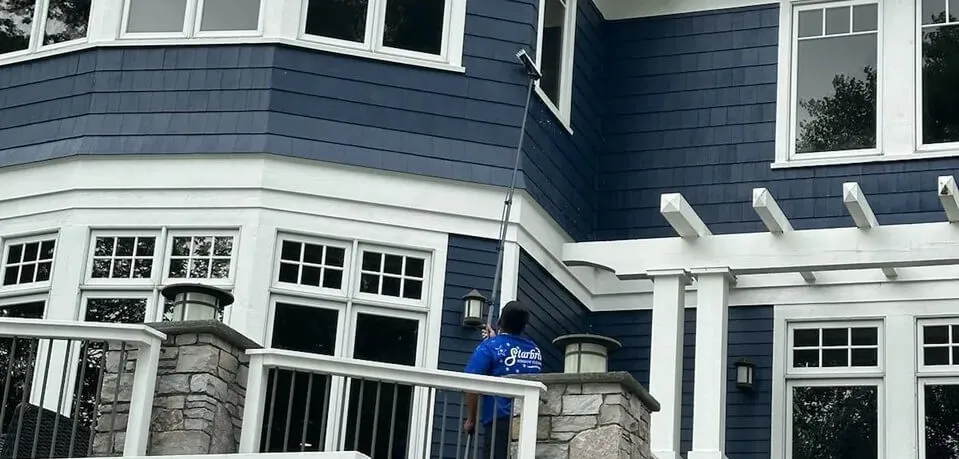
If the north side of your house has gone green, or you're staring at black streaks running down under the gutters, here's the short answer: that's living growth — algae and mildew — not a permanent stain, and it comes off. What removes it is a cleaning solution that kills the organism at the root, applied at low pressure and rinsed thoroughly. What does not remove it, and what causes most of the siding damage we get called out to look at, is a pressure washer cranked up and aimed at the wall. Below is what those marks actually are, how to deal with them safely, and how to keep them from creeping back every summer.
What Those Black Streaks and Green Patches Actually Are
Almost everything discoloring your siding falls into one of a few categories, and knowing which one you're looking at tells you how to treat it. Green film or a fuzzy green haze is algae — it feeds on moisture and the trace organic material that settles on your walls. Black spots and blotches are usually mildew or mold, which thrives in shade and humidity. Long black or gray streaks running vertically down from the roofline are typically a mix of algae and the oxidized runoff that washes off asphalt shingles and out of overflowing gutters. And a chalky white residue that rubs off on your hand is oxidation — the siding's finish breaking down from years of sun exposure, which is a different problem entirely and does not respond to cleaning solution the same way.
The important part: algae and mildew are alive. If you scrub off the visible layer without killing what's underneath, it regrows — often within weeks. That's the single biggest reason DIY siding cleaning tends to disappoint people. The wall looks great in July and looks the same as it did before by Labor Day.
Why It Shows Up on Some Walls and Not Others
Homeowners often notice one wall is filthy while the rest look fine. That's not your imagination. Growth follows moisture and shade, which in the Twin Cities means a fairly predictable pattern:
- North-facing walls stay shaded and damp the longest, so they green up first and worst
- Walls under tree canopy or next to fences hold humidity and get less drying sun
- Areas below gutters and downspouts collect runoff — and streaking there often means the gutters are overflowing or clogged
- Homes near lakes, ponds, and wetlands deal with higher ambient humidity year-round
- Sheltered spots behind decks, under overhangs, and around AC units rarely dry out fully
If one section keeps coming back dirtier than the rest, it's worth asking why. Chronic streaking under a gutter line is usually a gutter problem wearing a siding costume.
What Not to Do
Before the how-to, the short list of things that turn a cleaning job into a repair bill. Do not aim a pressure washer at vinyl siding at full strength — water forced up behind the panels can soak sheathing and insulation and feed mold inside your walls, and you may not notice for months. Do not spray upward under the panel laps, for the same reason. Do not use straight bleach on your siding: it's harsh on landscaping, hard on the finish, and it damages metal flashing and fasteners. Do not use a stiff wire brush, which scratches the surface and gives future algae more to hold onto. And do not clean a second story off a ladder with a hose or wand in your hands — falls are far and away the most common injury in DIY exterior cleaning, and the ladder is the part of the job most people underestimate.
A Safer Approach for Small Spots
If you're dealing with a small, reachable patch — a few square feet next to the back door, say — you can handle it yourself. The method is patience, not force:
- Rinse the area with plain water from a garden hose first, working top to bottom
- Soak nearby plants and shrubs with water before you start, and again when you finish
- Mix a gentle cleaning solution — a siding-safe outdoor cleaner, or a heavily diluted mix per the manufacturer's directions — and never combine it with any other cleaner
- Apply it with a soft-bristle brush or a pump sprayer and let it dwell several minutes so it can kill the growth, not just loosen it
- Scrub lightly with a soft brush on an extension pole, moving side to side rather than up under the laps
- Rinse thoroughly, top to bottom, until no residue is left behind
- Work in the shade and on a mild day — solution that dries on hot siding can leave its own streaks
That routine works fine for a spot check. For a whole house, or anything above the first floor, the math changes quickly.
Why Soft Washing Is the Right Answer for a Full House
Soft washing is the professional version of the approach above, done at scale. It uses low pressure — not much stronger than a garden hose — combined with a biodegradable cleaning solution that kills algae, mold, and mildew at the root. The chemistry does the work instead of the pressure, so the siding never takes a beating, water never gets driven behind the panels, and the results last considerably longer than a surface blast. It's also the method most siding manufacturers specify, which matters if your siding is still under warranty. Many vinyl warranties explicitly exclude damage caused by high-pressure washing.
A professional crew also brings the part that's hard to replicate in a driveway rental: the judgment about where not to spray. Soffit vents, electrical fixtures, window seals, light fixtures, and dryer vents all need to be worked around, and every house has a few spots that need a lighter touch.
How to Keep It From Coming Back
Once your siding is clean, a few habits stretch the results. Trim back shrubs and branches so walls get airflow and sunlight. Keep your gutters clean so runoff isn't painting streaks down your walls — clogged gutters are behind a surprising share of the black streaking we see. Redirect sprinklers that spray the house instead of the lawn. Walk the north side of your home each spring and catch the green early, while it's still a light haze. And plan on a full wash every one to two years for most Twin Cities homes, or annually if you're heavily shaded or close to water.
When to Call Someone In
Call a pro when the growth covers a large area, when it's above the first floor, when it keeps returning within a season or two, or when your siding is older and brittle from years of Minnesota freeze-thaw cycles. Older vinyl is far less forgiving than new panels, and that's exactly when people reach for more pressure — the worst possible instinct.
At Starbrite, we've been family-owned, minority-owned, and locally owned in Blaine since 1988. Our crews are OSHA and IWCA certified and BRC Aerial Lift trained, we're fully insured and licensed, and we've been BBB A+ accredited since 2012. Between more than 12,000 homes and 2,000 commercial properties cleaned across the metro, we've seen siding in every condition Minnesota weather can produce — and we know how to bring it back without hurting it.
If your walls have gone green, streaked, or spotted, we'd be glad to take a look. We serve homeowners throughout Anoka, Hennepin, Ramsey, Washington, Dakota, and Scott counties. Call us at (952) 922-6860 or use the Request a Quote button for a free, no-obligation estimate — we'll tell you honestly what your siding needs and what it doesn't.
Related service: Siding Cleaning