How Professionals Clean Second-Story Windows Safely
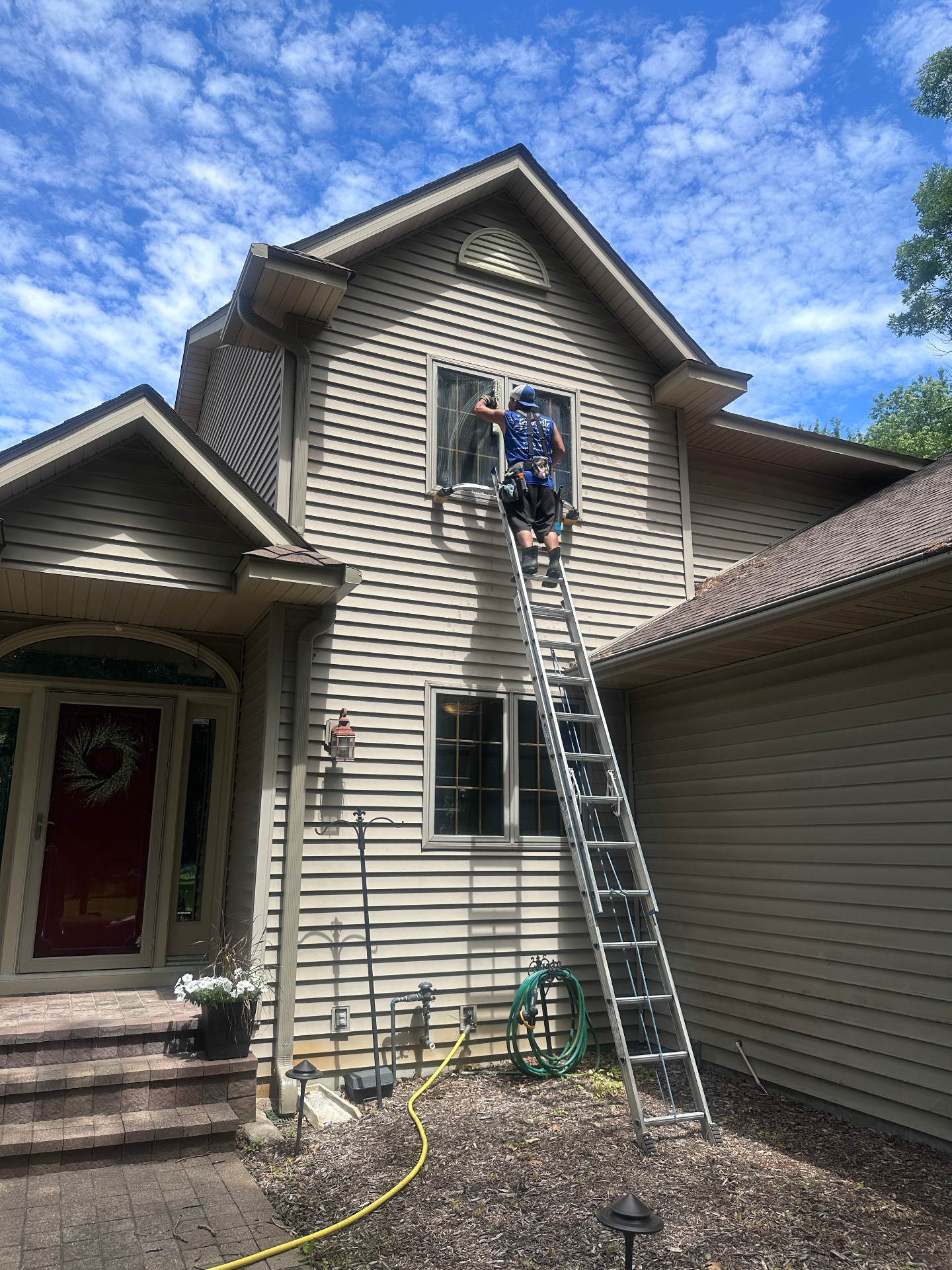
If you have ever watched a window cleaning crew work on your house, the second-story windows are usually where you pay the most attention. Someone is up on an extension ladder, reaching across glass that is well above head height, and it looks like the riskiest part of the whole job. It is also the part where the most preparation happens before anyone ever climbs a rung. What you see is a tech on a ladder. What you don't see is everything that happened first to make that ladder a safe place to work from.
Ladder setup is most of the job
A ladder that looks fine leaned against a house can still be set up wrong in ways that matter. The angle is the first thing a trained tech checks: too upright and the ladder can kick out at the base, too shallow and it puts unnecessary strain on the rails and can slip sideways. The general rule of thumb is roughly a 4-to-1 ratio, the base out about one foot for every four feet of height to the point of contact, and that gets confirmed on site rather than eyeballed. Footing matters just as much as angle. A Minnesota lawn in spring can be soft from thaw and rain, uneven from settling, or hiding a sprinkler head or edging right where a ladder foot wants to sit. A tech checks the ground the ladder is going to stand on before checking anything else, and will move to a different spot, use a leveling accessory, or switch equipment entirely rather than plant a ladder on ground that will not hold it steady.
Standoffs, stabilizers, and water-fed poles
One piece of equipment you may not notice is a ladder standoff, sometimes called a stabilizer bar. It holds the top of the ladder several inches off the wall or gutter line instead of resting directly against it, which keeps the ladder from resting its full weight on a gutter, downspout, or window trim that was never built to bear that load, and gives the tech room to reach glass without leaning the ladder itself sideways. On a growing number of jobs, the ladder never comes out at all. A water-fed pole system uses purified, deionized water pumped through a long pole with a soft brush head, scrubbing and rinsing the glass from the ground so it air dries spot-free without a squeegee pass, since the stripped-out minerals won't leave hard water spotting. Water-fed poles are especially useful for windows that are hard to safely ladder up to: over a garden bed, above a deck roofline, near power lines, or on a steep or soft section of yard where a ladder has nowhere good to stand.
When a lift is the right call
For taller homes, steep rooflines, windows above a porch or bay window that a straight ladder cannot safely reach, or commercial properties, an aerial lift is sometimes the better and safer tool. Lifts let a tech work from a stable platform at a controlled height rather than balancing equipment and technique on a ladder rung, and using one properly requires aerial lift certification, which is part of what separates a trained crew from someone with a ladder and a squeegee. It is more equipment and more setup, which is why it is reserved for the situations that actually call for it rather than used on every job.
Training, insurance, and why this matters
Falls from ladders are one of the most common reasons homeowners end up in the emergency room every year, and that is exactly why professional crews treat ladder work as a skill with real training behind it rather than something anyone can pick up by watching a video. OSHA training covers proper ladder angle, three points of contact, weight limits, and how to recognize ground and weather conditions that are not safe to work in. Liability and workers' compensation insurance matter too, because they protect both the homeowner's property and the technician if something does go wrong, which is not something you can assume about every person willing to show up with a ladder and a bucket.
What you can do to make the visit go smoothly
A homeowner cannot control the weather or the terrain, but there are a handful of simple things that make second-story window work faster and safer for whoever is doing it:
- Unlock any gates that lead to the side or back yard before the crew arrives, so a locked latch doesn't force a ladder into a worse spot
- Move cars out of the driveway if the crew needs that space for a ladder, water-fed pole setup, or lift
- Turn off automatic sprinklers for the morning, since wet ground under a ladder is exactly the footing a tech is trying to avoid
- Keep pets inside or in a fenced area away from where equipment will be set up
- Trim back or point out any low branches, trellises, or delicate plantings near second-story windows that might affect where a ladder can be placed
- Let the crew know about any recent yard work, holes, or soft spots in the lawn near the house that might not be obvious at a glance
None of this is complicated, but a few minutes of prep before the crew shows up removes a lot of the small obstacles that turn a simple ladder setup into a compromised one. The goal on every visit is the same: get a stable, correct setup before anyone reaches for a window, whether that means a ladder with a standoff, a water-fed pole from the ground, or a lift for the parts of the house nothing else reaches safely. If you have upstairs windows you have been putting off because the height makes you nervous, that is exactly what we are set up to handle. Give us a call at (952) 922-6860 or request a quote and we'll figure out the right approach for your house.
Related service: Residential Window Cleaning