How Often Should You Clean Your Gutters in Minnesota?
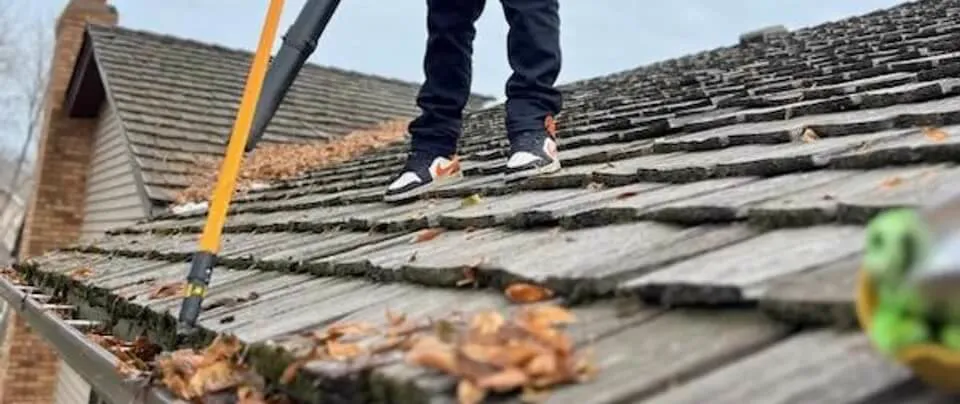
For most homes in the Twin Cities, gutters should be cleaned twice a year — once in late fall after the leaves have come down, and once in spring after the snow melts. That's the short answer, and for a lot of houses it's the whole answer. But Minnesota puts gutters through something homes in milder climates never deal with: months of freeze and thaw, heavy spring melt, and a fall leaf drop that arrives fast and then gets buried under snow. If your gutters are packed going into December, they can't do their job for the next four months. Below is how to figure out the right schedule for your home, what the warning signs look like, and why the timing matters even more than the frequency here.
The Twice-a-Year Baseline
Late fall and spring cover the two moments when clogged gutters do the most damage. The fall cleaning — ideally after the last leaves drop but before the first hard freeze — clears the season's debris so meltwater has somewhere to go all winter. The spring cleaning clears out whatever blew in over the winter, plus the shingle grit, seed pods, and maple helicopters that pile up fast in April and May.
That fall window is tighter in Minnesota than people expect. Wait too long and the debris in your gutters freezes into a solid plug you can't remove without risking damage to the gutter itself. Go too early and you're back up there in three weeks because half the leaves hadn't fallen yet. Most years, the sweet spot in the metro runs from late October into mid-November.
When Twice a Year Isn't Enough
Some homes genuinely need three or four cleanings a year. It usually comes down to what's growing above the roofline. You're likely a candidate for more frequent service if any of these describe your property:
- Mature trees overhanging the roof — especially oak, maple, cottonwood, or pine
- Pine or spruce nearby, since needles shed year-round and mat together into a dense clog
- A low-pitch roof, where debris settles instead of washing off
- Gutters that have overflowed or backed up before — a sign the system is undersized or the pitch is off
- Recent roof work, which sends shingle grit and nails into the troughs
- Persistent ice dam problems along one section of the roof
On the other end, a home on an open lot with no tree cover may do fine with one thorough fall cleaning and a spring inspection. The honest answer depends on your lot, not on a rule of thumb.
Why Minnesota Winters Raise the Stakes
In most of the country, a clogged gutter means water spills over the edge and lands where you don't want it. Here, it means something worse. When snow on the roof melts — from sun, or from heat escaping through the attic — that water runs down toward the eaves. If the gutter is packed with wet leaves, the water has nowhere to drain. It sits, it refreezes, and it starts building a ridge of ice at the roof edge.
That ridge is an ice dam. Each melt cycle adds to it, and water pools behind the dam and backs up under the shingles, where it can find its way into the sheathing, the insulation, and eventually the ceiling below. By the time you see a brown stain on the drywall, water has been in the wall assembly for a while. Clean gutters don't guarantee you'll never get an ice dam — attic insulation and ventilation matter enormously too — but blocked gutters make them substantially more likely and more severe.
There's a second winter problem: weight. Wet debris plus trapped ice can add serious load to a gutter run, and we've seen plenty of sections pull loose from the fascia over the winter simply because they were carrying more than they were built to hold.
Signs Your Gutters Need Attention Now
You don't have to get on a ladder to spot most of these. Walk the perimeter of your house after a good rain and look for:
- Water spilling over the front edge of the gutter instead of running to the downspout
- Downspouts that stay dry during a storm — a sure sign of a blockage upstream
- Plants or grass growing out of the gutter line
- Staining or streaking on the siding directly below the gutters
- Gutters visibly sagging or pulling away from the fascia board
- Soil eroding, mulch washing out, or pooling water along the foundation
- Peeling paint or rot on the fascia and soffit
Any one of those is worth acting on. A clogged gutter is one of the least expensive problems on your house to fix and one of the more expensive ones to ignore — water that ends up against the foundation instead of out in the yard is the beginning of basement seepage, and rotted fascia is a carpentry bill, not a cleaning bill.
What About Gutter Guards?
Guards help, and they're worth considering if you're surrounded by trees. But they're not the end of maintenance. Fine debris — shingle grit, pine needles, seed pods, roof moss — still gets through or collects on top of the guard itself, and guards can be their own problem in an ice dam scenario if they trap meltwater at the roof edge. Think of guards as reducing how often you need service, not eliminating it. Most guarded systems still want an inspection and a cleanout once a year.
What a Professional Cleaning Actually Includes
A real gutter cleaning is more than scooping leaves. When we're on a house, we clear the debris out by hand and haul it away rather than leaving it in your beds, flush the troughs so we can see water moving, check that every downspout runs free and clear it if it doesn't, and look over the hangers, seams, and fascia while we're up there. That last part matters — a loose hanger or a separating seam is a five-minute observation that saves a much bigger repair later. We'd rather tell you about it in October than have you find it in February.
This is also work where the ladder is the real risk. Second-story gutters, steep pitches, and wet fall leaves are a bad combination, and falls are the most common serious injury in DIY exterior maintenance. Our crews are OSHA-trained, and Starbrite is fully insured and licensed, so nobody's balancing on a ladder in your yard hoping it goes fine.
Booking Ahead in the Twin Cities
Fall gutter cleaning is the single most compressed job in this business. Every homeowner in the metro wants it done in the same three-week stretch between the last leaf and the first freeze, and schedules fill accordingly. If you know you want it done this fall, get on the calendar in September rather than calling the week the forecast turns. Spring is a little easier, but the same logic applies once the melt starts.
Starbrite Window Cleaning has been family-owned and locally owned in Blaine since 1988, and we've cleaned more than 12,000 homes and 2,000 commercial properties across the Twin Cities metro — Anoka, Hennepin, Ramsey, Washington, Dakota, and Scott counties. We're BBB A+ accredited, accredited since 2012, fully insured and licensed, and our crews carry OSHA, IWCA, and BRC Aerial Lift certification. If you're not sure whether your gutters need one cleaning a year or three, we'll take a look and tell you straight. Call (952) 922-6860 or request a quote — it's free, and there's no pressure attached to it.
Related service: Gutter Cleaning