How Multi-Story Commercial Buildings Get Their Windows Cleaned Safely
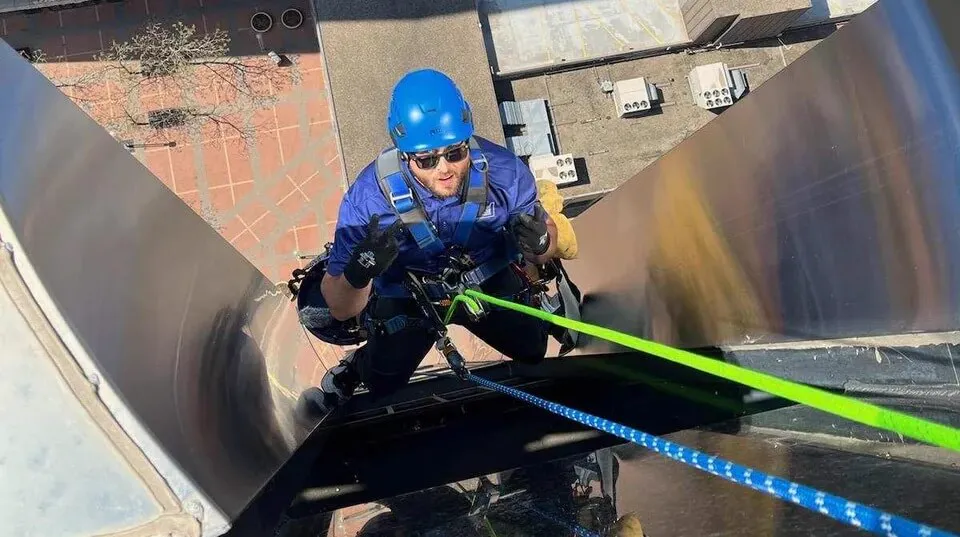
Once you get above the second floor, window cleaning stops being a ladder-and-squeegee job and becomes an access problem first, a cleaning problem second. Property managers often assume there's one method for tall buildings, but the right approach depends on how many stories are involved, what the roofline and grounds allow, and what the glass itself is set up for. Here's what's actually happening on the outside of a multi-story building when the windows get cleaned, and what to expect if you're signing off on the work.
Water-Fed Poles for Low- and Mid-Rise Buildings
For buildings roughly up to five or six stories, water-fed pole systems are often the first choice. These systems run purified, deionized water through a long carbon-fiber pole with a brush head at the end, all controlled from the ground. Because the water has had its minerals stripped out, it dries completely spot-free without a squeegee pass, which is why the windows are typically left to air dry rather than wiped down. The appeal for building owners is that nobody has to go up at all: crews stay on the ground or on a low ladder, which cuts down on both cost and risk. The limitation is reach and water pressure. Past a certain height, the pole gets harder to control and the system's effectiveness on stubborn grime drops off, which is where taller buildings move to a different method entirely.
Aerial Lifts, Rope Access, and Swing Stages for Taller Work
Beyond what a water-fed pole can reach, and depending on what's on the ground and the roof, buildings are cleaned with one of a few access methods. Aerial lifts, often boom lifts, are common where there's enough clear pavement or lawn around the building to position the equipment, and operators need aerial lift certification to run them. Rope descent systems and bosun's chairs are used on buildings with proper roof anchor points, lowering a technician on ropes rigged to fixed or portable anchors, often with a secondary independent safety line as backup. High-rises with permanent building maintenance units use swing stages, the suspended platforms you'll see hanging on cables from a roof-mounted rig, which let a two-person crew work across a wide section of glass at once. Which method a building uses often comes down to what was built into the structure: a high-rise with roof anchors and davit bases has more options than an older mid-rise that never had exterior access equipment installed.
What OSHA and IWCA Standards Actually Require
OSHA fall protection rules and IWCA (International Window Cleaning Association) safety standards aren't paperwork, they shape how the work happens on the building. Anchor points have to be inspected and rated before anyone hangs off them, and that inspection is documented, not assumed. Rope access work generally requires a two-person rule, meaning a technician is never working alone on a suspended line without someone else present or in communication. Fall protection means a backup line independent of the primary line a technician is descending on, so a single point of failure doesn't become a fall. Weather limits matter more than people expect: wind speed thresholds, lightning, and temperature can shut down exterior high work for the day, since a swinging platform in a 25 mile-per-hour gust is a real hazard, not a minor inconvenience. A crew that's OSHA-trained and IWCA-familiar will tell you plainly when conditions aren't safe, and that's a sign they know what they're doing, not a delay to fight.
Insurance and Certificates: What to Ask For
Before any crew goes above the ground floor on your property, ask for a certificate of insurance naming your building or management company as an additional insured, and confirm the policy covers the work being done: general liability at minimum, and workers' compensation is non-negotiable given the job. If rope access or swing stage work is involved, ask whether technicians carry relevant training or certification for that access method specifically, since general window cleaning experience doesn't automatically mean rope or lift competency. This isn't an unusual request and a legitimate commercial window cleaning company will have these documents ready without hesitation. If a vendor is reluctant to produce a certificate or gets vague about who's actually rated to run the lift or rig the ropes, treat that as a real warning sign, not a formality to skip past.
Scheduling Around Tenants, Parking, and the Minnesota Season
Exterior high work on an occupied building means coordinating around more than just the crew's calendar. Aerial lifts and swing stage rigging need clear ground space, so parking lot sections or sidewalks near the work zone often get blocked off temporarily, and tenants need a heads-up before equipment shows up outside their windows. Good scheduling also means working floor by floor or elevation by elevation so the disruption to any one tenant is brief rather than an all-day event. In the Twin Cities, weather narrows the working season more than most people realize: high work generally happens spring through fall, once temperatures stay reliably above freezing and before winter wind, ice, and short daylight make rope access, lift work, and swing stages unsafe. That's a shorter window than ground-level cleaning gets, one reason exterior high-rise work often needs to be booked well ahead of when a manager wants it done.
- Water-fed pole systems handle roughly up to five or six stories using purified water and no chemicals.
- Aerial lifts require clear ground access and an aerial lift certified operator.
- Rope descent systems and bosun's chairs depend on inspected, rated roof anchor points.
- Swing stages suit high-rises with permanent roof-mounted rigging for wide glass sections.
- A two-person rule and an independent backup line are standard fall protection on rope work.
- Wind, lightning, and cold can pause exterior high work for the day regardless of the schedule.
- A current certificate of insurance naming your building as additional insured should be provided without being asked twice.
- Minnesota's high-work season generally runs spring through fall, so book ahead of when you need it done.
For a deeper look at how often commercial buildings should have their windows cleaned, or a broader property manager's guide to the process, we've covered those separately. When you're ready to talk through what access method fits your building and how scheduling would work around your tenants and parking, Starbrite Window Cleaning has been doing this across the Twin Cities metro since 1988. Request a quote or call (952) 922-6860 to get a site walk scheduled.
Related service: Commercial Window Cleaning