Fall Gutter Cleaning: Why Timing Matters Before the First Freeze
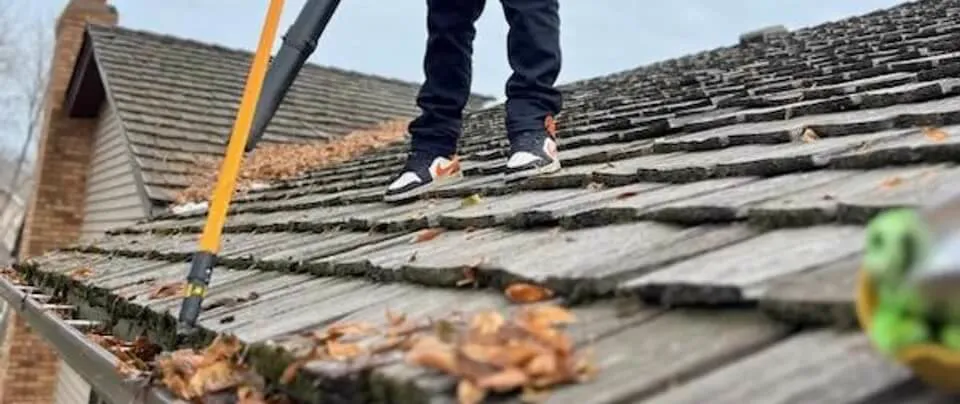
The best time to clean your gutters in the Twin Cities is after your trees have finished dropping and before the debris inside freezes solid — for most metro homes that lands somewhere between late October and mid-November. That's a narrow target, and it moves every year depending on the weather. Miss it early and you're paying to do the job twice. Miss it late and the leaves in your gutters turn into a frozen plug that can't safely come out until spring. Neither one is the end of the world, but both are avoidable if you understand how the fall calendar actually works around here.
Why the First Freeze Is the Real Deadline
Gutter debris is not dry. By late fall the leaves, seed pods, shingle grit, and pine needles sitting in your troughs have absorbed weeks of rain. That mixture behaves like wet mulch, and when the temperature drops below freezing and stays there, it turns into a single frozen mass locked to the bottom of the gutter.
At that point the job changes completely. Frozen debris can't be scooped — it has to be chipped or pried, and gutter aluminum is thin and brittle in the cold. Seams separate. Hangers pull loose from the fascia. You can absolutely damage a perfectly good gutter run trying to clean it in December, which is why an honest company will tell you to leave it and revisit in spring rather than take your money for a job that costs you more than it saves.
The Twin Cities typically sees its first light freeze in early-to-mid October and its first hard freeze — the kind that stays below freezing for days — in late October or early November. That hard freeze is the real deadline, not the first frosty morning.
Your Trees Set the Start Date, Not the Calendar
The other half of the timing problem is that trees don't all drop at once. Booking a cleaning in early October feels responsible, but if your lot has oaks, you'll be looking at full gutters again by Halloween.
Rough order of leaf drop across the metro:
- Ash, birch, and cottonwood — early, often mostly down by the first week of October
- Maple and elm — mid-October, and heavy; a single silver maple can fill a gutter run on its own
- Linden and honeylocust — mid to late October, with small leaves and pods that pack downspouts tightly
- Oak — late October into November, and some varieties hold brown leaves well past the first snow
- Pine and spruce — needles shed year-round with a heavy push in fall, and they mat together like felt
So the right start date for your house depends on what's growing over it. A yard with a couple of birches can be handled in mid-October and be fine. A yard with mature oaks and a spruce line really shouldn't be touched until the first week of November.
When One Cleaning Isn't Enough
For a lot of Twin Cities homes, a single fall pass does the job. For others, two is simply the honest answer, and we'd rather say so up front than have you disappointed in three weeks.
You're probably a two-pass house if you have heavy tree cover directly over the roofline, a mix of early and late-dropping species, a low-pitch roof that holds debris instead of shedding it, or gutters that already overflowed at least once this year. In that case the usual approach is a cleaning in mid-October to clear the early volume, and a second visit in early November after the oaks finish. The second visit is the one that matters for winter — it's what determines whether meltwater has somewhere to go during a January thaw.
What Happens If You Skip It
Clogged gutters going into a Minnesota winter cause more expensive problems than clogged gutters in July. Water that can't drain goes somewhere, and in winter it goes somewhere and then freezes.
- Frozen debris gives ice a foundation to build on at the roof edge, making ice dams form earlier and grow bigger
- Trapped ice plus soaked debris is heavy enough to pull gutter runs off the fascia entirely
- Overflow saturates fascia and soffit boards, and wet wood that freezes and thaws repeatedly starts to rot
- Water spilling at the foundation freezes and expands against the wall, and in spring that same overflow finds its way into basements
- Standing water and organic debris at the eave shortens shingle life right where the roof is most vulnerable
None of that is dramatic in year one. It's the third and fourth winter that produces the repair bill.
Book Earlier Than You Think You Need To
Here's the practical problem with a three-week window: every homeowner in the metro wants the same three weeks. Late October is the single busiest stretch of the year for exterior work in the Twin Cities, and it's also the stretch most likely to be interrupted by rain, wind, or an early snow that pushes every crew's schedule back a few days.
September is the right time to get on the calendar. You're not asking for the work to happen in September — you're reserving a slot in the window that suits your trees, so that when the leaves come down you're already scheduled instead of calling around. Homeowners who wait until they can see their gutters are full are calling during the exact week everyone else is.
What a Real Fall Cleaning Includes
Scooping leaves is the easy part. A cleaning that's actually worth doing before winter covers more than that. Our crews clear the debris by hand and haul it away rather than dropping it in your landscaping, flush the troughs so we can watch water move the way it should, confirm every downspout runs free and clear it when it doesn't, and check hangers, seams, and fascia while we're up there.
That last piece is where the value is. A loose hanger or a separating seam is a two-minute note in October and a carpentry bill in February. We'll tell you what we find either way, and we'll tell you if we think you don't need us again until spring.
It's also worth saying plainly that ladder work on wet leaves in a Minnesota October is how a lot of people get hurt every year. Our crews are OSHA trained, and Starbrite is fully insured and licensed, so nobody is standing on a wobbling ladder in your yard hoping for the best.
Starbrite Window Cleaning has been family-owned, minority-owned, and locally owned in Blaine since 1988. We've cleaned more than 12,000 homes and 2,000 commercial properties across the Twin Cities metro — Anoka, Hennepin, Ramsey, Washington, Dakota, and Scott counties. We're BBB A+ accredited, accredited since 2012, and our crews carry OSHA, IWCA, and BRC Aerial Lift certification. If you'd like to know whether your house is a one-pass or a two-pass job, tell us what's growing in your yard and we'll give you a straight answer. Call (952) 922-6860 or request a quote — it's free, and there's no pressure attached to it.
Related service: Gutter Cleaning