Do Dirty Solar Panels Really Lose Efficiency?
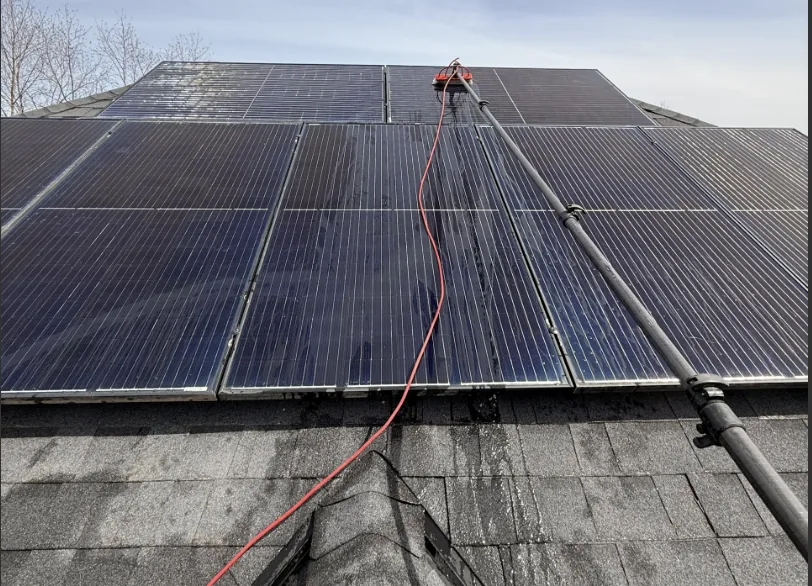
Short answer: yes, dirty solar panels lose efficiency — but the honest version of that answer has a range in it. A thin, even film of dust across an array typically costs you somewhere in the low single digits of annual production. A few well-placed bird droppings, a band of pollen paste along the bottom edge of every panel, or a season of cottonwood fluff cemented on by rain can cost you a great deal more than that. The difference isn't how dirty the panels look. It's how the dirt is distributed. That's the part most homeowners don't hear, and it's the part that actually decides whether cleaning is worth your money.
How Soiling Actually Costs You Power
A solar panel makes electricity from the light that reaches its cells. Anything sitting on the glass — dust, pollen, ash, salt, organic grime — scatters or absorbs a portion of that light before it gets there. Spread evenly across the whole array, that's a straightforward, gradual loss. Industry field data generally puts uniform soiling losses in temperate, regularly rained-on climates at roughly two to five percent of annual production, with dry, dusty, or agricultural areas running higher.
But panels aren't wired like a row of independent light meters. Cells inside a panel are strung together in series, and a series string is limited by its weakest member. Shade one cell heavily and it doesn't just subtract that cell's output — it drags down the whole group it's wired into, until a bypass diode kicks in and takes that entire section of the panel offline. That's why a single dried bird dropping the size of a quarter can knock out a third of a panel's output, while a light haze of dust over the same panel barely registers.
So the useful question isn't "are my panels dirty?" It's "is anything on my panels concentrated and opaque?"
What Lands on Panels in the Twin Cities
Minnesota isn't the desert, and we're not going to tell you your array is silently bleeding twenty percent. We get real rain through most of the production season, and rain does a decent job on loose dust. But rain is not a cleaning service, and there's a specific list of things around here that rain doesn't handle:
- Spring tree pollen, which turns to a sticky yellow film that rain smears rather than removes
- Cottonwood fluff in early summer, which mats along frames and lower edges and then bakes on
- Bird droppings — the single most expensive kind of soiling per square inch, and the most common on low-slope residential arrays
- Roof grit and asphalt granules washing down from shingles above the array
- Construction, road, and field dust, especially on the metro's growing edges
- Organic growth and dark staining along the bottom aluminum frame where water sits after every rain
- Ice-melt residue and grime carried down by melting snow through a Minnesota winter
That last item is worth a note. Snow itself mostly takes care of itself — it slides off tilted panels as they warm, and there's not much production to lose in December anyway. The problem is what the melt leaves behind at the bottom edge of each panel: a persistent band of grime that sits exactly where a shadow does the most damage, and that sticks around into the high-production months of spring.
How to Tell If Cleaning Is Worth It on Your Roof
You don't have to guess. Most home solar systems come with monitoring — an app or web dashboard that logs daily production. That data will tell you more than any visual inspection.
Compare a clear, sunny day this month against a clear, sunny day in the same week last year, or right after your last rain. A gradual, steady decline across seasons is usually normal panel aging, which runs well under one percent a year. A drop that shows up over weeks or months, doesn't recover after a good rain, and holds even on cloudless days is the signature of soiling. If your system reports per-panel or per-string output, look for one panel lagging its neighbors — that's the fingerprint of concentrated, localized shading, and it's the case where cleaning pays for itself fastest.
You can also just look, from the ground, with binoculars if you have them. Even film, mild concern. Distinct dark spots, streaks, or a solid dirty band along the bottom of every panel — worth addressing.
Why This Isn't a DIY Job
We understand the instinct to grab a hose and a brush. Here's why we'd rather you didn't. Solar panel glass has an anti-reflective coating that abrasive pads, scrub brushes, and household cleaners will permanently scratch and haze — and once you've dulled that coating, you've traded a temporary soiling loss for a permanent one. Pressure washing is worse: high pressure can drive water past the panel seals and into the junction box, which is both a production problem and an electrical one. Cold water on hot midday glass can crack it outright. And most manufacturers' warranties have specific language about cleaning methods, which is a bad thing to discover after the fact.
Then there's the roof itself. A residential array is usually on a pitched surface, and wet glass is one of the least forgiving things a person can stand near. Falls from roofs are the reason companies like ours carry the certifications we do.
How Starbrite Cleans Solar Panels
We use purified, deionized water and soft-bristle equipment on extension poles, working from ladders or lifts rather than walking your array. Deionized water matters more than it sounds like it should: ordinary tap water in the metro carries dissolved minerals that dry into exactly the kind of spotting you were trying to remove. Pure water lifts the grime and evaporates clean, with no soap residue left on the glass to attract the next round of dust.
We work panel by panel, we pay particular attention to the bottom frame edge where the worst of it collects, and we tell you honestly if we don't think your array needs it. For most Twin Cities homes, once a year — ideally late spring, after the pollen has finished and before the peak production months — is the right rhythm. Arrays near fields, busy roads, construction, or heavy tree cover may want twice.
The Bottom Line
Dirty panels do cost you production. For a typical clean-ish Minnesota array, that's a modest number and cleaning is maintenance, not rescue. For an array with bird droppings, a pollen crust, or a grime band along every bottom edge, the losses stop being modest — and the fix is a single visit.
Starbrite Window Cleaning has been family-owned, minority-owned, and locally owned in Blaine since 1988. We're BBB A+ accredited since 2012, fully licensed and insured, and OSHA, IWCA, and BRC Aerial Lift certified. We've cleaned more than 12,000 homes and 2,000 commercial properties across the Twin Cities metro, from Anoka and Hennepin down through Ramsey, Washington, Dakota, and Scott counties.
If you're not sure whether your panels need attention, call us at (952) 922-6860 or Request a Quote and we'll take a look. If they don't need cleaning, we'll say so.
Related service: Solar Panel Cleaning